
Most conversations about excavation bidding software focus on speed — how much faster a takeoff runs, how much time a report saves. Speed matters, but it’s an internal metric. The number that actually affects the business is win rate: how many of the bids you submit turn into awarded work. Those aren’t automatically the same thing. A contractor can bid faster and still lose the same percentage of jobs if the bid itself doesn’t hold up against the competition.
This article looks at excavation bidding software from the win-rate side: how the software affects what a bid actually looks like to a GC or owner, how many bids a team can realistically pursue, and where speed indirectly turns into more awarded work rather than just less overtime.
Faster estimating gives a contractor two separate advantages, and it’s worth treating them separately:
More bids pursued. If a takeoff and report that used to take a full day now takes a few hours, the same estimating team can reasonably pursue more opportunities in the same period. More bids submitted, at a consistent quality level, generally means more awarded work over time — even if the win rate on any individual bid doesn’t change.
More time spent on each bid. Alternatively, that same time savings can go into reviewing a bid more carefully, testing an alternate grading scenario, or double-checking a quantity before submission — which can improve the win rate on individual bids rather than the volume submitted.
Which of these matters more depends on whether a contractor is capacity-constrained (not enough time to bid on everything worth pursuing) or accuracy-constrained (losing bids due to pricing or quantity issues). Excavation bidding software affects both, but a contractor should be clear on which problem they’re actually solving before assuming faster automatically means more wins.
A takeoff number, however accurate, isn’t what a GC evaluates directly — they evaluate the bid document. Detailed project reports, including graphical analysis, cross-sections, and annotated drawings, are what actually gets reviewed alongside the price. Two bids with similar pricing can look very different in credibility depending on whether the supporting documentation is a clean, professional report or a bare spreadsheet of numbers.
This matters more on complex or high-value projects, where an owner or GC reviewing multiple competing bids is more likely to trust a submission that clearly shows how a quantity was derived — through cross-sections and visual site models — over one that just states a total.
Generating and viewing the project model in 3D has an internal use — catching errors before submission — but it also has an external use that’s easy to underweight: it changes how a bid gets received. A 3D model included in a proposal gives a client or GC something concrete to review, rather than asking them to trust a set of numbers on faith. On a competitive bid where the client is comparing several contractors, a visual site model can be the difference between a bid that reads as thorough and one that reads as generic.
This is less about the software itself and more about what a contractor chooses to include in the submission — but it’s only possible to include if the software generates that visual model as part of the normal workflow, rather than requiring a separate step to produce something presentation-ready.
Some bids are won or lost on price and scope alone. Others come down to which contractor got a complete, credible bid in front of the client first, especially when a GC is working against their own deadline and needs bids back quickly to build their own proposal. Excavation bidding software that shortens the time between receiving plans and having a submission-ready report gives a contractor a practical edge in exactly that situation — not because the number is better, but because it arrived when the client needed it.
This is a different kind of advantage than accuracy or presentation quality, and it’s worth tracking separately: a contractor who’s occasionally lost bids simply because they couldn’t turn a proposal around in time is solving a different problem than one losing bids on price.
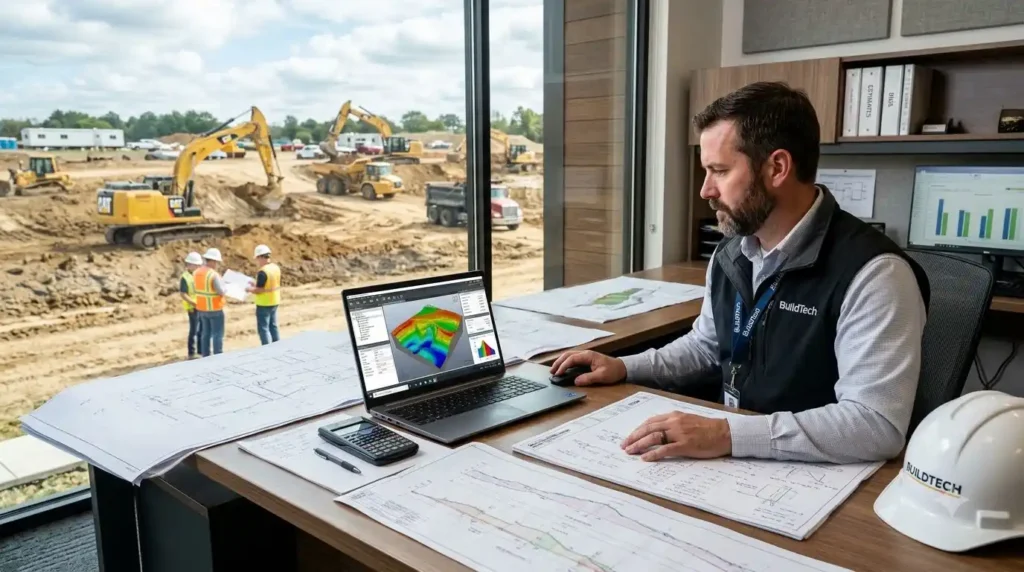
EarthWorksOS connects digital earthwork takeoff, cut-and-fill calculation, 3D visualization, and reporting within one workflow, which shortens the path from receiving plans to having a submission-ready proposal. Its detailed project reports — with graphical analysis, cross-sections, and annotated drawings — are generated directly from the same takeoff data used for the estimate, so a presentation-ready document doesn’t require separate manual formatting before it can be submitted. It runs on standard Windows-based systems, and a 14-day free trial is a practical way to see how much faster a full bid package comes together compared to your current process.
Treating faster estimating as automatically better win rate. Speed without a plan for how to use the extra time — more bids pursued, or more review per bid — doesn’t reliably translate into more awarded work on its own.
Submitting a bare quantity without supporting documentation. A number without cross-sections or a visual model asks a GC to trust the math without being able to see it, which is a harder sell on a competitive bid.
Skipping the 3D review before submission. Beyond catching internal errors, this is often the same visual the client would see — worth confirming it actually represents the site accurately before it goes out.
Underestimating turnaround time as a competitive factor. A contractor who consistently submits complete bids faster than competitors is solving a different problem than a contractor bidding at the same speed but with a stronger price — both matter, but they require different fixes.
Overcommitting to concurrent bids without a workflow that supports it. Running several bids in parallel without connected takeoff, calculation, and reporting tools often means quality drops across all of them rather than gaining real capacity.

Empowering contractors with accurate, intuitive earthwork estimating.
Copyright © 2025 EarthWorks (construction excavation software).